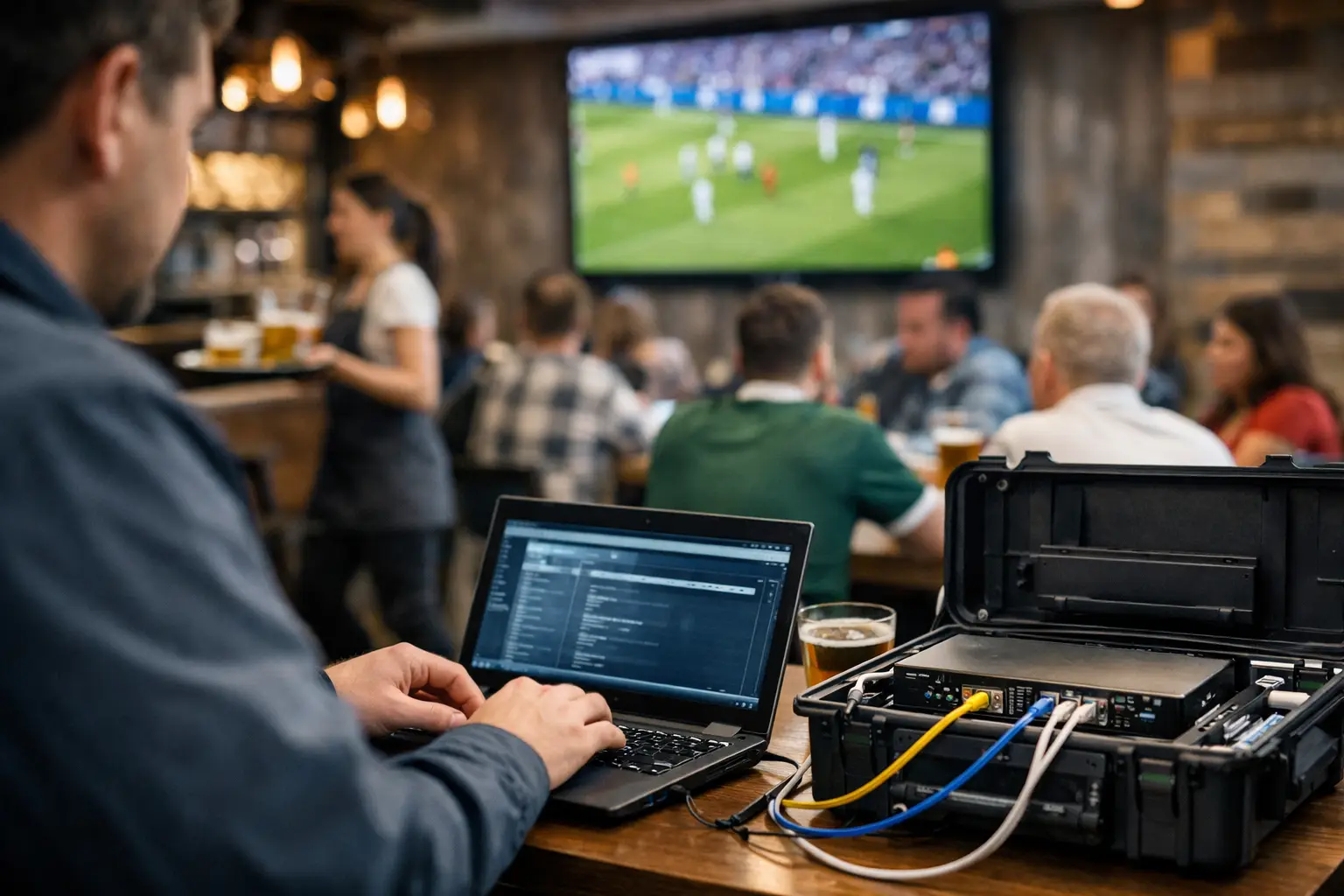
A packed dining room can turn a minor network fault into a visible business failure in minutes. The POS terminals stop processing cards, guest WiFi slows to a crawl, streaming buffers at the moment customers expect the match, and staff are left explaining a problem they cannot fix. A restaurant network recovery service is built for that moment: isolate the failure, restore critical operations, and keep a local technical team focused on the clock.
For Atlanta restaurants preparing for World Cup traffic, recovery cannot mean submitting a ticket and waiting for a general help desk. Match-day demand changes the technical environment. More devices connect at once. More guests stream, post, pay, and move through the venue. A network that performs adequately on a normal Tuesday can fail under a full house with every screen running.
Why Restaurant Network Failures Escalate Fast
Restaurants depend on more than an internet connection. They depend on a chain of systems that must work together under pressure: the primary circuit, firewall, switches, wireless access points, POS terminals, payment processing, streaming devices, kitchen displays, and staff tablets. A fault at one point can look like a failure everywhere.
That distinction matters during recovery. If guests cannot connect to WiFi, the cause could be overloaded access points, poor channel planning, an exhausted DHCP pool, a bad switch port, or an upstream outage. If every payment terminal is down, the issue may be a local LAN failure, a DNS problem, an ISP interruption, or a payment provider issue. Restarting equipment without diagnosis can waste the most expensive minutes of the event.
The business impact is immediate. Slow video sends customers elsewhere. Failed card transactions reduce sales and create friction at the table. A disconnected kitchen system delays orders. When staff switch to manual workarounds, errors rise as service speed drops. Public visibility makes the damage worse because guests remember where they missed the moment.
What a Restaurant Network Recovery Service Should Do
A serious recovery service is not simply remote troubleshooting. It is a coordinated response designed around restoring the functions that protect revenue first. That typically means payment processing, streaming, internal communications, and core venue connectivity, in that order based on the restaurant's operating model.
The first task is triage. An engineer needs to confirm the scope: one screen, one zone, one VLAN, the full restaurant, or the internet circuit itself. That narrows the recovery path quickly. A venue-wide loss of connectivity calls for a different response than a WiFi issue affecting only the patio.
Next comes containment and restoration. If a firewall is unstable, traffic may need to move through a prepared backup configuration. If the primary internet circuit has failed, a tested failover connection should carry essential traffic. If guest usage is overwhelming the network, traffic controls may need to prioritize POS and streaming devices while limiting nonessential demand.
Finally, recovery should include verification. Restoring a green status light is not enough. The team should validate card transactions, test key streams on the screens guests are watching, confirm staff devices reconnect, and check whether the network remains stable as traffic returns. The goal is operational service, not a partial technical fix.
Recovery Priorities Change by Venue
A quick-service restaurant may need POS and online ordering restored before anything else. A sports bar may put broadcast streaming and screen reliability at the top of the list because the event is the product driving occupancy. A hotel restaurant may need to preserve business operations while separating a guest WiFi problem from staff systems.
That is why generic IT support often falls short. The correct fix depends on the venue's revenue flow, physical layout, installed equipment, and the exact failure occurring at that time. A recovery partner should understand those dependencies before match day, not while a manager is trying to calm a full room.
Recovery Starts Before the Outage
The fastest incident response is built on preparation. A restaurant that waits until the network is down must spend precious time identifying equipment, finding provider information, locating credentials, and determining whether a backup connection exists. Those are readiness tasks, not emergency tasks.
A focused pre-event review should map the network and identify what cannot fail. That includes the primary and backup internet paths, firewall configuration, switch capacity, wireless coverage, streaming equipment, POS network segmentation, and power protection. It should also identify single points of failure. One aging switch, one overloaded access point, or one untested cellular backup can put the entire operation at risk.
Capacity testing matters as much as hardware inventory. World Cup crowds create concentrated demand: hundreds of devices arriving close together, customers uploading video, multiple displays pulling high-bitrate streams, and staff processing transactions continuously. Bandwidth alone does not guarantee performance. WiFi density, radio interference, device limits, VLAN design, and traffic prioritization all affect the guest experience.
The trade-off is straightforward. Adding capacity or failover costs money before the event. Losing transactions, tables, and reputation during a high-value match costs money when there is no time left to recover it. For venues expecting tournament-driven traffic, readiness is usually the more controllable expense.
The Difference Between Failover and Real Recovery
Failover is essential, but it is not a complete recovery strategy. A secondary circuit can keep a restaurant online when the primary ISP goes down, provided it was configured, tested, and sized for the load. It may not handle every stream, guest device, and back-office process at full capacity. That is normal. The objective is to preserve critical services until the primary path returns or engineers complete a repair.
Real recovery also accounts for failures that failover cannot solve. A backup circuit will not repair a misconfigured firewall rule, a failed switch, overloaded WiFi, a compromised device, or a streaming platform issue. Restaurants need visibility into where the outage begins and an escalation plan that matches the problem.
For that reason, monitored environments have an advantage. When a support team can see circuit health, device status, bandwidth utilization, and wireless alerts before doors open, it can often catch deterioration early. A growing error rate or an access point repeatedly dropping clients is a warning, not a harmless anomaly.
Build a Match-Day Response Plan That Staff Can Use
The best technical plan still fails if the floor team does not know what to report. Managers should have a simple escalation process that identifies the symptom, the affected area, the time it began, and whether POS, streaming, or guest WiFi is impacted. Clear information gives engineers a faster starting point.
Staff should also know which workarounds are approved. That may include moving payments to designated terminals, shifting a display to an alternate source, or directing guests to a different seating area while wireless issues are isolated. Improvised resets and disconnected cables can make diagnosis harder, so employees should know when to stop and escalate.
A local partner adds value here. Atlanta venues do not need to explain why a seven-minute interruption during a major match is different from a routine office outage. GDS Technology approaches recovery as a live-operations problem, with local engineering support and a focus on the systems customers can see and staff need to run the room.
What to Expect When You Call for Help
A capable response begins with direct questions: What is down? What still works? Is the problem affecting one device, one area, or the entire venue? Is the primary circuit online? Are payment terminals processing? Are streams failing on every screen or only selected devices?
From there, the priority should be clear communication and decisive action. The restaurant needs a realistic status, an immediate path to restore critical operations, and an explanation of what is being tested. If an onsite visit is required, the technician should arrive prepared to work with venue infrastructure, not begin by guessing where the network closet is.
After service is restored, the incident should produce an operational improvement. That may mean replacing a weak component, separating guest traffic more aggressively, increasing wireless coverage, documenting a failover procedure, or scheduling a pre-event load review. The outage is costly. Repeating the same outage is optional.
Your restaurant does not get a second chance to deliver the match customers came to watch. Treat network recovery as part of event operations, prepare the venue before the crowd arrives, and make sure the team responsible for uptime can respond at the speed your business requires.