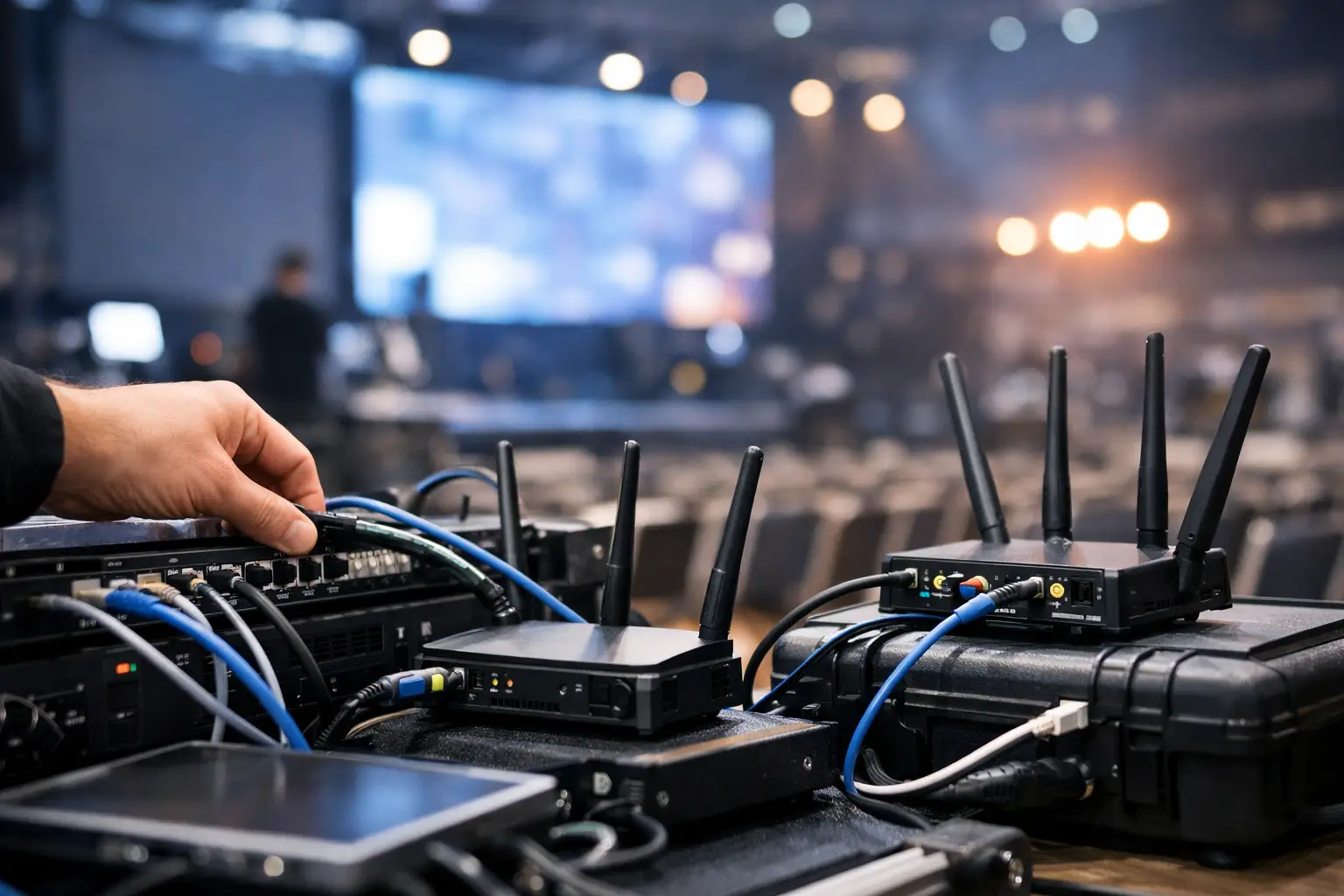
A match is minutes from kickoff, every seat is full, mobile orders are stacking up, and three TVs just dropped the stream. That is when network failover planning for events stops being a technical nice-to-have and becomes an operations decision with immediate revenue impact. For bars, hotels, venues, and broadcasters in Atlanta, a backup connection only matters if it takes over fast, preserves critical traffic, and has already been tested under load.
Why network failover planning for events matters more during live sports
Live event traffic does not fail gracefully. It spikes hard, often all at once, and it hits multiple systems at the same time. Guest WiFi demand climbs, point-of-sale terminals stay active, IPTV or streaming endpoints consume bandwidth continuously, security cameras remain online, and staff devices compete for airtime. If a primary circuit degrades or drops, the business problem is not just lost internet. It is interrupted sales, frustrated guests, broken service workflows, and a room full of people noticing.
That is especially true during tournament windows, rivalry matches, and citywide event surges. In those moments, the weakest part of your setup gets exposed fast. Sometimes it is the ISP. Sometimes it is a misconfigured firewall. Sometimes the backup line exists on paper but routes through the same provider path and fails for the same reason. Real failover planning is about removing single points of failure, not just checking a box that says backup internet is installed.
What good failover planning actually includes
Most venue operators think first about redundancy at the circuit level. That is a good start, but it is not enough. Effective network failover planning for events has to cover connectivity, routing, traffic prioritization, wireless performance, and recovery procedures.
At the connectivity layer, the first question is simple: if your primary internet provider fails, what takes over, and how different is that backup path? A secondary circuit from the same carrier may help with local modem issues, but it may not help if the outage is upstream. A diverse backup, such as a second wired provider or properly engineered 5G failover, gives you a better chance of surviving a real disruption.
At the routing layer, the handoff matters as much as the backup itself. Automatic failover should trigger quickly and predictably. If your team has to log into a device, rewrite rules, or reboot hardware during a crowd event, that is not failover. That is manual recovery, and manual recovery is too slow when the room is full and staff are already under pressure.
Then there is traffic policy. Not every system deserves equal treatment during an outage. Payment processing, core streaming endpoints, operational communications, and business-critical applications should take priority over public guest usage. If backup bandwidth is lower than your primary circuit, and it usually is, your network has to know what to protect first. Without that policy, failover can technically work while the guest experience still collapses.
Start with business priorities, not hardware specs
The most common planning mistake is buying equipment before defining what must stay online. A sports bar may decide the top priority is live stream continuity and POS uptime. A hotel may care most about front desk systems, property management software, and guest-facing broadcast feeds. A venue may place ticket scanning, broadcast production, and security operations at the top of the list.
Those priorities shape the design. They tell you which VLANs need protection, which applications need quality-of-service rules, and what acceptable degradation looks like during a failover event. They also force the right budget discussion. If the business impact of ten minutes offline is measured in lost tabs, refunds, chargebacks, and public complaints, investing in a properly segmented and tested failover design becomes easier to justify.
This is where experienced event support teams separate themselves from generic IT providers. They know that a venue under live load behaves differently than an office on a normal weekday. GDS Technology works in that reality, where recovery speed and traffic prioritization matter more than abstract uptime claims.
The trade-offs between wired backup and wireless failover
There is no single best backup path for every venue. A second wired circuit typically offers better stability and more predictable throughput, especially for high-density streaming environments. It is often the stronger choice for larger venues, broadcast-heavy spaces, and hospitality locations that cannot tolerate bitrate fluctuation.
Wireless failover, including 5G, can still be a smart part of the plan. It deploys faster, works well for temporary event setups, and can provide critical continuity for POS traffic, operational systems, and limited stream protection. But wireless performance depends on signal quality, local congestion, building materials, and match-day crowd density. If thousands of guests are also using the same mobile networks, your wireless backup may be available but constrained.
That does not make wireless a bad option. It means expectations and engineering need to be realistic. In some environments, 5G is an excellent tertiary path rather than the primary backup. In others, it is the most practical failover option available. The right answer depends on venue size, budget, broadcast requirements, and tolerance for degraded service during a circuit loss.
Testing is the part that most venues skip
Failover plans fail most often because nobody tested them end to end. A link appears active, but DNS breaks. The firewall flips to backup, but the stream encoder keeps trying to use the dead route. Guest WiFi reconnects slowly. POS sessions stall. Staff discover in real time that the backup line was never sized for actual event traffic.
Testing needs to be deliberate and repeatable. That means forcing a primary outage during a controlled window and observing what happens to every critical service. How long does the switch take? Which applications recover automatically? Which ones require reconnection? Does video quality hold at an acceptable level? Can guests still transact? Can staff still operate?
The answers should be documented, not assumed. If your plan depends on a five-minute reconnection process, that may be acceptable for back-office systems and unacceptable for front-of-house streaming. If backup capacity only supports partial service, that is manageable if everyone knows the order of protection before game day.
WiFi and failover are connected problems
Many event operators separate internet redundancy from wireless performance, but guests experience them as one system. If the internet fails over successfully but the wireless environment is overloaded, sticky clients remain attached to weak access points, or guest traffic is not segmented from operations, the room still feels broken.
That is why event-grade planning includes wireless design review. Access point placement, channel planning, band steering, client limits, and SSID separation all affect how well the venue performs during a degraded state. When backup bandwidth is tighter, poor WiFi hygiene becomes even more expensive. Every unnecessary guest device competing with operational traffic raises the chance that the systems you care about most will slow down.
Security cannot be an afterthought during failover
Outage conditions create risk. Teams are distracted, temporary changes get made quickly, and monitoring may be reduced while everyone focuses on restoring service. That is exactly when weak remote access policies, exposed management interfaces, or poorly controlled guest networks become dangerous.
A sound failover plan keeps security controls intact during both primary and backup operation. Firewall rules should remain consistent. Network segmentation should not disappear just because traffic moves to another circuit. Remote access should stay restricted and logged. If your backup path bypasses the controls that protect payment systems or production networks, you traded one operational problem for another.
Build for the event you expect and the one you do not
The best failover designs are practical. They assume something will go wrong at the worst possible time and reduce the number of decisions your team has to make under pressure. That usually means documented priorities, diverse connectivity, automatic path switching, bandwidth policies, active monitoring, and local support that can respond without delay.
It also means accepting that resilience is not free. More redundancy costs more. More segmentation adds complexity. More testing takes time. But the alternative is paying for downtime during the exact moments your venue is supposed to perform at its best.
If you are preparing for a high-traffic sports calendar in Atlanta, the right question is not whether you have backup internet. The right question is whether your venue can lose its primary path and keep the match on screen, payments flowing, staff connected, and guests unaware that anything happened. That is the standard worth planning for.