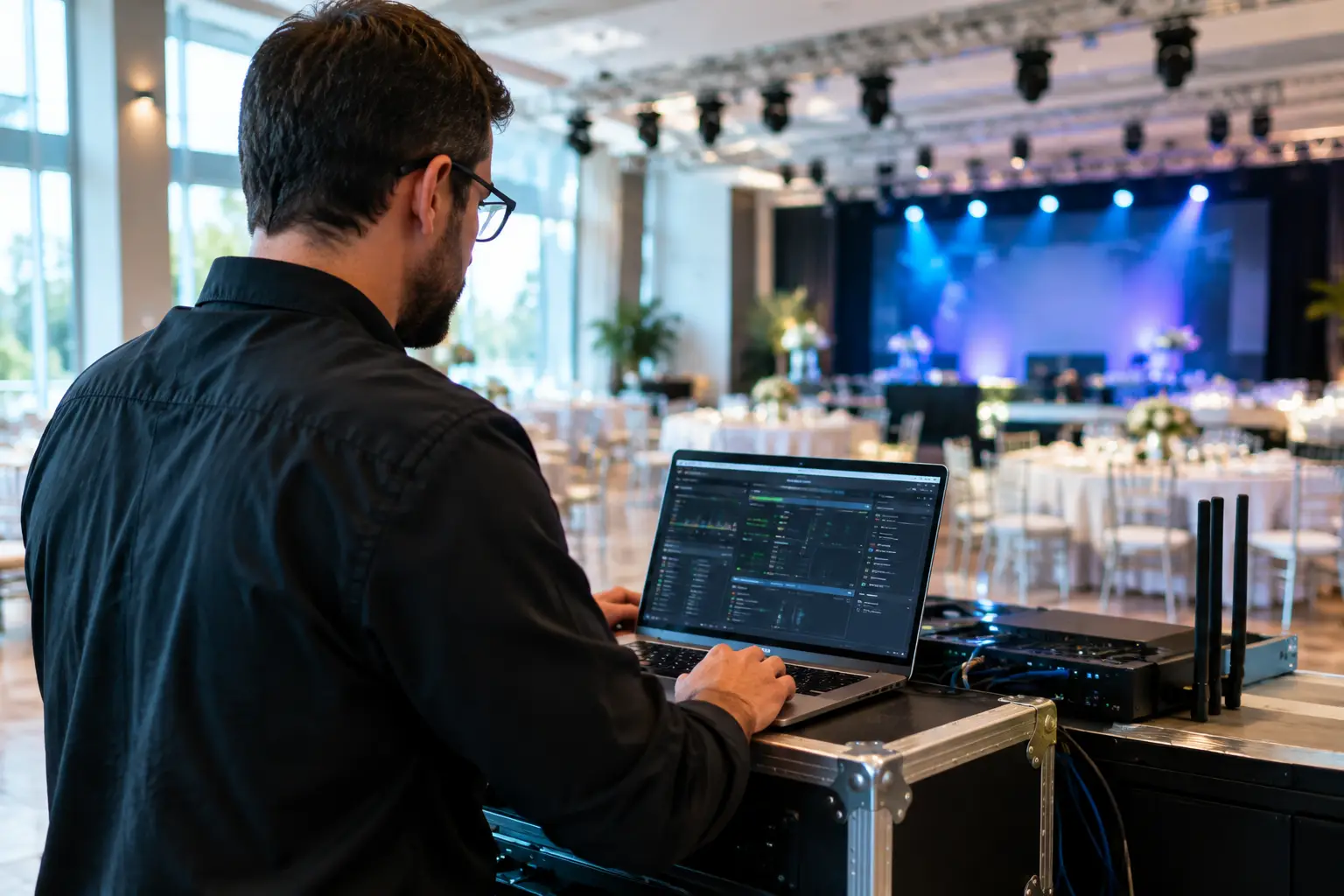
A packed venue can lose revenue long before the internet goes completely down. Video begins to buffer on a featured match. Point-of-sale terminals hesitate. Guests abandon WiFi. Staff start rebooting equipment while a manager tries to reach a provider that does not understand the urgency. Managed IT for event venues exists to prevent that chain reaction and to contain it fast when a failure still occurs.
For Atlanta bars, hotels, restaurants, event spaces, broadcasters, and sponsor activations preparing for high-demand sports traffic, IT is not back-office overhead. It is part of the guest experience, the transaction flow, and the public-facing product. A venue needs an IT partner built for the period when every screen, connection, and payment matters most.
Why event-venue IT fails under pressure
Most connectivity problems are not caused by one obvious equipment failure. They are the result of an environment operating beyond its normal assumptions. A venue may have sufficient bandwidth on a quiet Tuesday, then struggle when hundreds of guests arrive with multiple devices, staff stream content across several displays, payment traffic spikes, and a promotional activation adds new wireless hardware to the network.
The visible symptom might be poor video quality. The underlying problem could be saturated WiFi access points, poor channel planning, an overloaded firewall, a misconfigured switch, a failing internet circuit, or traffic from guest devices competing with critical systems. Treating every problem as "the WiFi is bad" wastes the minutes that matter most.
Live events also expose weak recovery planning. Many businesses have an internet provider, a router, and someone who can call support. That is not the same as having monitored infrastructure, documented network topology, tested failover, priority escalation paths, and local engineers prepared to respond. When a major match is in progress, a generic help desk ticket is rarely an acceptable recovery plan.
Managed IT for event venues means active readiness
A venue-focused managed IT service should begin before doors open. The purpose is not merely to maintain devices. It is to identify what can interrupt operations, reduce the likelihood of failure, and establish a clear response path if conditions change.
That starts with visibility. Engineers need to know the status of internet circuits, firewalls, switches, access points, streaming devices, and critical endpoints. Monitoring should distinguish between a short disruption, a worsening performance issue, and a full outage. It should also reveal whether the problem sits inside the venue, at the internet provider, with a streaming platform, or at a specific display or endpoint.
The next requirement is network separation. Guest WiFi should not compete freely with point-of-sale terminals, staff systems, security cameras, building controls, or the devices responsible for video distribution. Segmenting traffic does not guarantee perfect performance, but it limits the blast radius when a guest device, misconfigured endpoint, or bandwidth-heavy application creates trouble.
Finally, readiness requires ownership. Someone must be accountable for deciding whether to restart, reroute, replace, escalate, or switch to backup connectivity. During an event, uncertainty is expensive. A team that understands the venue layout and system dependencies can make those decisions faster than an unfamiliar remote technician working from a generic script.
The four systems that deserve match-day protection
Venue operators do not need to turn every technology decision into a major project. They do need to protect the systems that carry immediate operational risk:
- Primary and backup internet connectivity: A secondary connection can keep payments, communications, and selected streaming functions operating when the primary circuit fails. The correct backup depends on the venue's traffic needs, budget, and physical location.
- Business-critical WiFi and wired networks: Coverage, capacity, access-point placement, switch health, and traffic segmentation must be validated for peak occupancy, not average daily use.
- Streaming and video distribution: The feed, playback devices, displays, audio synchronization, content rights requirements, and network path all need testing before guests arrive.
- Cybersecurity and access control: Event periods attract increased phishing, rogue-device, credential, and payment-system risk. Account access, firewall policies, firmware, backups, and incident response procedures require attention before the surge.
There are trade-offs. A larger backup circuit costs more. More aggressive guest WiFi controls can create support requests. Network segmentation requires planning and documentation. But the alternative is accepting that a preventable failure will occur at the most visible moment of the day.
Streaming reliability is a venue operations issue
Guests do not separate a streaming failure from the rest of their experience. If the match freezes, they do not care whether the fault belongs to the venue, an ISP, a device manufacturer, or an application provider. They see a venue that was not ready.
That is why streaming support must include more than checking download speed. Engineers should validate the full delivery path: internet connection, DNS behavior, firewall policies, device performance, app authentication, display connections, audio routing, and any local distribution equipment. A feed that works on one television may still fail across a multi-screen setup if devices are configured differently or network traffic is poorly prioritized.
A practical test should mirror event conditions as closely as possible. Run the intended streams, use the actual playback hardware, connect representative guest devices, process test transactions, and observe whether performance changes as load increases. If a venue relies on a backup connection, test the cutover. A failover plan that has never been exercised is an assumption, not a safeguard.
Response speed changes the cost of downtime
The difference between a five-minute disruption and a 45-minute outage can be thousands of dollars in lost sales, refunds, staff distraction, and reputational damage. It can also affect future bookings when corporate clients or event organizers see that the venue cannot support a high-profile crowd.
Response speed depends on preparation. A support team needs current credentials, network documentation, equipment inventory, escalation contacts, and permission to take action. If the first 20 minutes of an outage are spent locating a network closet key, confirming who owns the firewall, or searching for an ISP account number, the venue has already lost valuable time.
Local support also matters when the issue is physical. A remote engineer can diagnose a disconnected cable, a failed power supply, or an overheated switch only to a point. For Atlanta operators facing tournament-scale traffic, GDS Technology provides local engineering support designed for the systems and failure patterns common to live event environments. The goal is direct: restore service, protect the guest experience, and keep the venue operating.
What a venue readiness review should uncover
A useful readiness review does not produce a vague technology scorecard. It produces decisions. It should identify which circuit is primary, what takes over when it fails, where coverage is weak, which devices have reached end of life, what traffic receives priority, and who responds after hours.
It should also expose dependencies that venue teams often overlook. Does the point-of-sale system require a specific network path? Are security cameras consuming capacity during peak traffic? Can staff access the management interface when guest WiFi is overloaded? Is a critical streaming account tied to a former employee's email address? Does the venue have current contact information for every carrier and platform provider?
The answers shape the right investment. A smaller venue may need better access-point placement and a tested cellular backup. A large hotel or multi-room event property may need redesigned segmentation, redundant hardware, stronger monitoring, and dedicated on-site coverage for major dates. There is no single configuration that fits every building, but every venue needs a plan tied to its actual revenue risk.
Build for the crowd you expect, not the quiet day you had
Major sports events create a simple test of operational discipline: can the venue keep screens live, transactions moving, guests connected, and staff focused when demand reaches its highest point? Managed IT should give operators a confident answer before the crowd arrives.
The most valuable next step is to map one upcoming high-attendance event from doors-open to final whistle. Identify every system the guest will touch, every system staff depend on, the failure point most likely to disrupt each one, and the person responsible for recovery. That exercise turns IT from a background expense into what it is during a live event: a protected part of the operation.