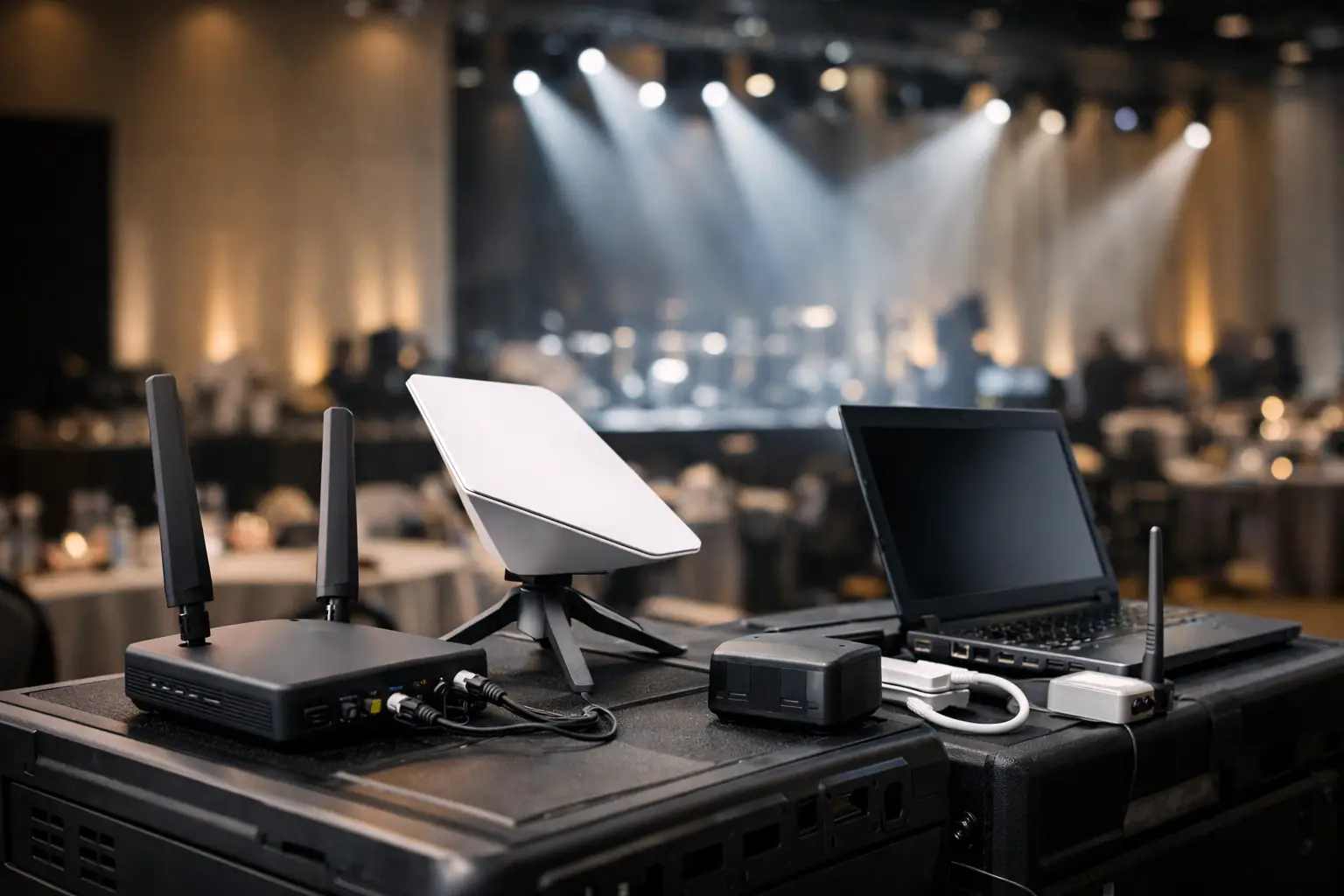
When the main circuit drops 10 minutes before kickoff, nobody in the building cares why. They care that the screens stay live, card payments keep clearing, guest WiFi still works, and your staff is not taking the blame for an ISP problem. That is why the best backup internet options are not a nice-to-have for bars, hotels, venues, and event operators in Atlanta. They are part of match-day risk control.
For high-traffic sports environments, backup internet is less about buying a second connection and more about designing failover that fits revenue-critical systems. A sports bar showing multiple live feeds has a different tolerance for disruption than a hotel supporting guest WiFi, IPTV, front desk systems, and conference traffic. A venue with ticketing, scanners, POS, and live production has a different problem again. The right answer depends on what must stay online first, how fast failover needs to happen, and what kind of outage you are actually trying to survive.
What the best backup internet options need to do
A useful backup connection must solve more than total internet loss. In live event settings, partial failure is common. You may still have a circuit up, but packet loss destroys streaming quality. DNS may fail. Upload speeds may collapse. One provider may route traffic poorly during regional congestion. If your backup plan only covers a hard outage, it may still fail when the room is full and every screen matters.
The best backup internet options for venues have three jobs. First, they preserve critical traffic such as streaming, POS, payment terminals, ticketing, VoIP, and operational apps. Second, they fail over quickly enough that staff and guests do not feel the transition. Third, they use physically and logically different paths, so one local issue does not take down both services.
That last point gets missed all the time. Two circuits from the same carrier in the same conduit may look redundant on paper and fail together in the real world.
The strongest backup internet options for live event environments
Secondary wired internet from a different carrier
For most commercial sites, this is the most reliable starting point. A second wired circuit from a different provider gives you the best balance of speed, stability, and sustained performance under load. If your primary service is fiber, the backup may be cable, fixed wireless, or another fiber provider with a truly separate last-mile path.
This approach works well for hotels, sports bars, and venues with constant traffic because it can carry heavy demand for longer periods. If a major match runs three hours and your primary line is out the entire time, a real wired backup has a much better chance of holding up than a cellular-only plan.
The trade-off is cost and installation complexity. It takes planning, carrier coordination, and verification that the backup path is actually diverse. But if internet downtime directly affects revenue, this is usually the benchmark option.
5G or LTE failover
Cellular failover is fast to deploy and often the smartest layer of immediate resilience. With the right router and data plan, 5G or LTE can take over automatically when the main line fails. For smaller sites or specific critical systems, it can be enough on its own. For larger venues, it is often the right tertiary path or rapid-response fallback while wired service is restored.
Its biggest advantage is path diversity. A fiber cut or local ISP outage does not necessarily affect cellular service. It is also useful for emergency response, temporary events, outdoor activations, and locations where a second wired circuit is not practical.
The limitations matter. Cellular performance changes with crowd density, tower load, building materials, and time of day. On a major match day in Atlanta, nearby users can compete for the same radio resources you are depending on for failover. That makes cellular a strong backup for prioritized traffic, but a risky choice if you expect it to fully replace a large venue's primary broadband without traffic controls.
Fixed wireless internet
Fixed wireless can be an excellent middle ground when available. It offers a separate access method from wired broadband and often delivers better consistency than consumer-grade cellular failover. For sites with line-of-sight access and a provider experienced in business service delivery, fixed wireless can support serious operational traffic.
This option is especially attractive for buildings where adding another wired carrier is slow or expensive. It can also create true last-mile diversity if your primary provider relies on underground cable and your fixed wireless path is independent.
The trade-off is location sensitivity. Performance depends on provider coverage, installation quality, environmental conditions, and local spectrum conditions. It is not a universal answer, but in the right building it can be one of the best backup internet options available.
Dedicated circuits for critical systems only
Not every venue needs a full-site redundant internet stack. In some cases, the smarter move is to isolate business-critical traffic onto its own protected path. That could mean keeping POS, ticketing, payment processing, and a small set of streaming feeds on a dedicated backup connection while guest WiFi and nonessential traffic drop or degrade during failover.
This model is often more cost-effective because it matches protection to business impact. If your guest WiFi slows down for 20 minutes, that is annoying. If card payments stop or the main match feed freezes across every screen, that is a direct revenue and brand problem.
The key is traffic engineering. Without proper prioritization, a backup circuit can get flooded the moment users and devices reconnect.
How to choose the best backup internet options for your venue
Start with application priority, not carrier marketing. Ask which systems must stay live through an outage and what downtime actually costs during peak hours. For a sports bar, top priority may be streaming feeds, POS, payment terminals, and manager communications. For a hotel, it may include front desk systems, guest services, IPTV, door systems, and conference operations. For a broadcaster or event organizer, low latency and stable upload performance may matter more than raw download speed.
Next, define failover tolerance. If a 60-second interruption is acceptable, your design can be simpler. If even a brief stream interruption creates visible customer impact, you need tighter routing, better monitoring, and tested automatic failover.
Then look at diversity. The best backup internet options are only as strong as their physical separation. Different bills do not always mean different infrastructure. Confirm whether providers share poles, conduits, neighborhood nodes, or building entry points.
Finally, test under realistic conditions. Run failover during business hours. Push streaming traffic. Process transactions. Check DNS behavior, VPN reconnection, and WiFi controller response. A backup line that works in a quiet test can still fail under event load.
Common mistakes that make backup internet fail when it matters
The first mistake is assuming dual internet equals resilience. It does not if both services ride the same local infrastructure, terminate in the same weak firewall, or lack automatic failover.
The second is treating all traffic equally. Guest devices, staff phones, smart TVs, cameras, and streaming boxes can saturate a backup path fast. Without segmentation and priority rules, critical business traffic competes with everything else.
The third is never validating the failover process end to end. Many teams test that a router switches links, but they do not test whether payment systems reconnect cleanly, whether live video sessions recover acceptably, or whether staff know what they should and should not do during an outage.
The fourth is ignoring WiFi design. Sometimes the internet circuit is not the real bottleneck. During major events, overloaded access points, poor channel planning, bad client steering, or misconfigured VLANs can create symptoms that look like ISP failure.
A practical recommendation for Atlanta event operators
For most high-visibility commercial environments, the safest design is a layered one: primary wired broadband, secondary service from a truly different carrier or access method, and cellular failover for emergency continuity. Pair that with traffic prioritization so streaming, POS, and operational systems stay protected first.
If your building hosts major sports crowds, this is not something to leave untested until tournament week. Match-day conditions expose every weak assumption in a network. GDS Technology works with Atlanta venues that cannot afford that kind of surprise, especially when public demand spikes and every outage is visible in real time.
The best backup internet option is the one that has already failed in testing, already been corrected, and is ready before the room fills up.