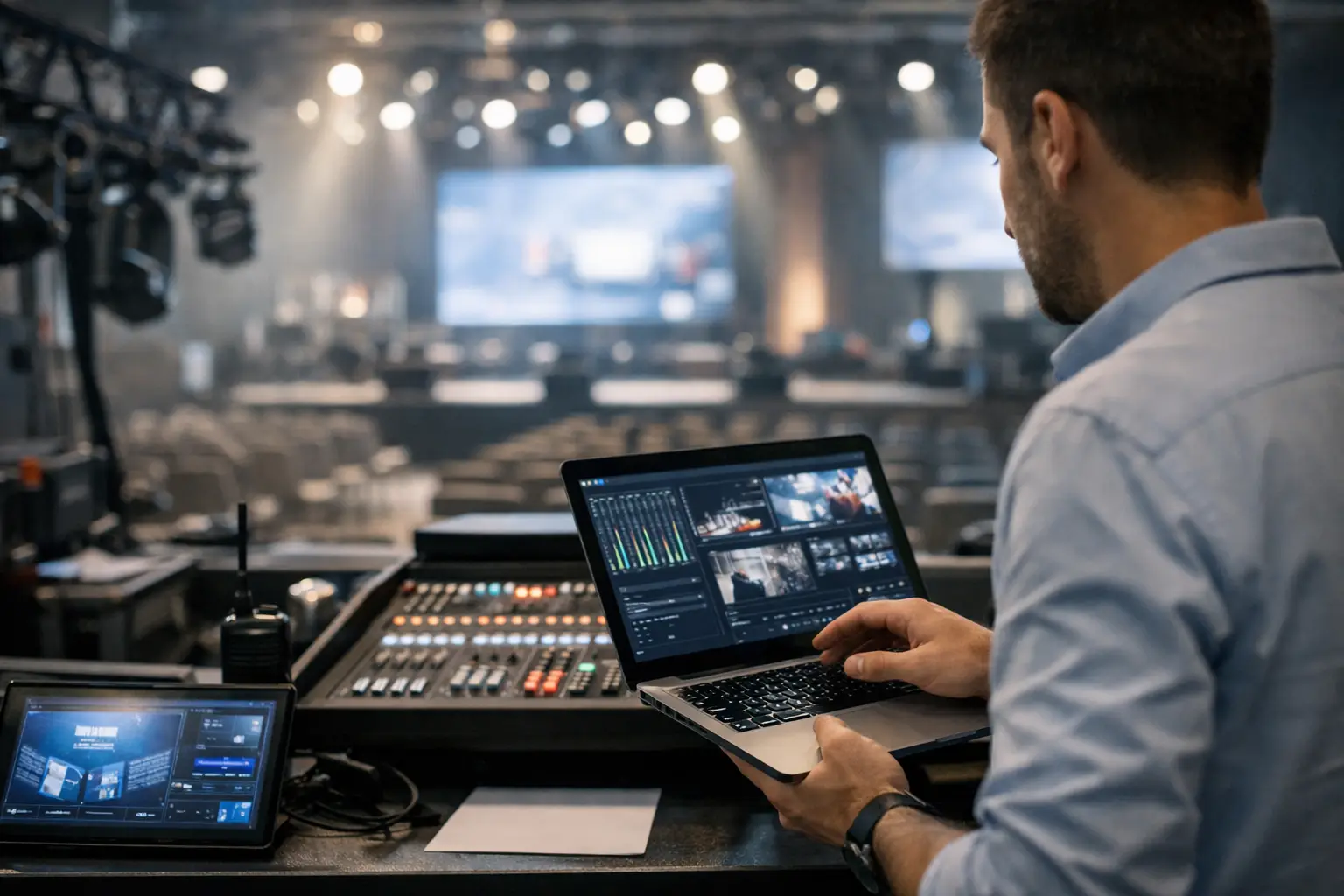
A packed room does not break your technology. Unplanned demand does. When a match starts, every screen, payment terminal, POS device, guest phone, IPTV feed, and back-office system begins competing for bandwidth and uptime at the same time. A venue technology readiness audit is how operators find the weak points before customers do.
For Atlanta bars, hotels, venues, and event hosts preparing for major sports traffic, this is not a paperwork exercise. It is an operational check on whether your network can carry live streams without pixelation, whether guest WiFi can absorb a surge, whether failover actually works, and whether one bad switch or access point can take out revenue during peak hours. If your venue will be judged in real time by guests, sponsors, and staff, readiness has to be verified, not assumed.
What a venue technology readiness audit actually measures
A good audit looks past general IT health and focuses on event pressure. Standard office benchmarks are not enough for a bar showing multiple matches, a hotel hosting watch parties, or a sponsor activation pushing high guest concurrency. The question is not whether the internet works on a normal Tuesday morning. The question is whether the environment stays stable when demand spikes fast and stays elevated.
That means reviewing internet capacity, LAN performance, WiFi design, streaming paths, DHCP behavior, VLAN segmentation, switching health, firewall rules, backup circuits, content delivery dependencies, and security exposure. It also means validating the physical layer. A badly terminated cable, an overloaded access point, or an unmanaged switch tucked behind a display can become the source of a visible outage.
The strongest audits also look at operations, not just hardware. Who gets alerted first when a stream drops? How quickly can staff isolate a problem? Is there a documented escalation path? Can the venue fail over without waiting for a vendor callback? Readiness is technical, but it is also procedural.
Why match-day environments fail differently
Live sports traffic creates a specific kind of stress. It is concentrated, time-sensitive, and public. Guests are not casually browsing. They are watching, posting, ordering, checking scores, and expecting every screen to stay live. One interruption ripples across the room fast.
This changes the risk profile. In a normal business setting, a network issue may slow down a team internally. In a venue, it affects customer experience, transaction volume, dwell time, and brand credibility within minutes. If the stream freezes during a key play, nobody cares that your ISP shows the circuit as technically up.
There is also the concurrency problem. Operators often underestimate how many devices connect at once, how much multicast or video traffic is crossing internal segments, or how many systems share the same uplink. A venue may think it has enough bandwidth because speed tests look fine in isolation. Under real conditions, airtime contention, poor channel planning, and bottlenecks between switches can still degrade service.
That is why a venue technology readiness audit needs to model reality, not theory. It should reflect crowd behavior, screen counts, event schedules, and the way staff actually work under pressure.
The core areas every venue technology readiness audit should cover
Internet service is the obvious starting point, but not the only one. Capacity matters, yet raw bandwidth numbers can hide design flaws. Auditors should verify primary and backup connectivity, confirm failover timing, and test whether critical services route correctly during an outage. A backup circuit that exists only on paper is not backup.
WiFi deserves equal attention because guest expectations are unforgiving. Coverage maps are useful, but performance is what counts. The audit should check access point placement, density, roaming behavior, interference, power settings, channel overlap, and whether guest traffic is isolated from business systems. In high-traffic venues, WiFi problems are often design problems, not ISP problems.
Streaming infrastructure is another major category. Venues that rely on internet-delivered feeds need validation across devices, apps, encoders, displays, and control paths. Small failures here create big visibility. HDCP issues, firmware mismatches, aging HDMI extenders, and unstable local distribution can look like internet problems when they are not.
Security cannot be left out just because the event is customer-facing. Public traffic, temporary staff, vendor devices, and third-party activations all increase exposure. The audit should review patch status, endpoint controls, remote access settings, segmentation, password practices, and monitoring visibility. High-profile events attract attention from more than fans.
Then there is the back-office layer. POS systems, reservation tools, kitchen printers, digital signage, security cameras, and staff communications all depend on the same environment. If these systems share infrastructure without proper prioritization or segmentation, one surge can affect everything at once.
What operators usually miss before a major event
Most venues do not ignore technology. They simply inherit networks that grew in pieces. A new patio got added. Extra TVs were installed for playoffs. A vendor dropped in a switch. Guest WiFi expanded without redesign. Over time, the environment becomes functional but fragile.
The first common miss is assuming bandwidth solves everything. More bandwidth helps, but it does not fix poor WiFi architecture, bad QoS policy, weak switching, or local distribution issues. The second is failing to test failover under live conditions. Many operators have a backup line they have never fully exercised with streaming, POS, and guest traffic active.
The third miss is underestimating physical infrastructure. Heat, cable wear, power instability, and unsecured equipment racks can all create intermittent failures that only appear under load. The fourth is relying on vendor silos. The ISP, the AV team, the POS provider, and the internal IT contact may each see only part of the environment. A proper audit looks across the whole stack.
How to use audit findings without overbuilding
Not every venue needs a full redesign. The value of a venue technology readiness audit is that it separates critical risks from nice-to-have upgrades. Some sites need a second circuit and tested failover immediately. Others need access point repositioning, cleaner segmentation, or replacement of a few unstable components.
This is where trade-offs matter. If a venue has a limited pre-event window, the right move may be targeted remediation focused on uptime, stream stability, and payments first. Cosmetic improvements can wait. On the other hand, if the audit shows deep structural problems, patching around them may cost more than addressing the root cause.
Operators should prioritize by business impact. Ask which failures stop transactions, interrupt broadcasts, or create room-wide customer frustration. Those are the items to fix first. Then look at issues that increase support time or reduce visibility when something breaks.
The best remediation plans also include ownership and timing. Who is responsible for each fix, who validates it, and when is it retested under load? Without that discipline, audits become documents instead of readiness tools.
Timing matters more than most venues think
The wrong time to start is the week of the event. By then, vendor schedules tighten, replacement hardware gets harder to source, and any configuration changes carry more risk. Audits need enough lead time for testing, remediation, and retesting.
For venues expecting elevated traffic around major sports events, the smartest approach is to audit early, remediate in phases, and run a controlled stress test before the first critical date. That gives operators time to prove failover, validate screen performance, and train staff on escalation procedures.
It also gives local support teams a chance to understand the venue before an emergency. That familiarity shortens response time when minutes matter. In high-stakes environments, local engineering presence is not a luxury. It is often the difference between a contained issue and a lost night.
What good looks like on event day
Good does not mean nothing goes wrong. Good means the venue can absorb pressure, isolate faults fast, and keep core services running. Screens stay live. POS keeps processing. Guest WiFi remains usable. Staff know who to call and what to do first.
That level of stability rarely happens by accident. It comes from testing the environment the way customers will use it, identifying the single points of failure, and fixing the items most likely to cause public disruption. That is the practical value of a venue technology readiness audit.
For Atlanta operators preparing for major match traffic, the smartest move is simple: treat readiness like revenue protection. If your venue depends on uptime to fill seats, move drinks, support sponsors, and protect your reputation, verify the technology now while there is still time to fix what matters.
When the room is full and every screen matters, confidence should come from proof, not hope.