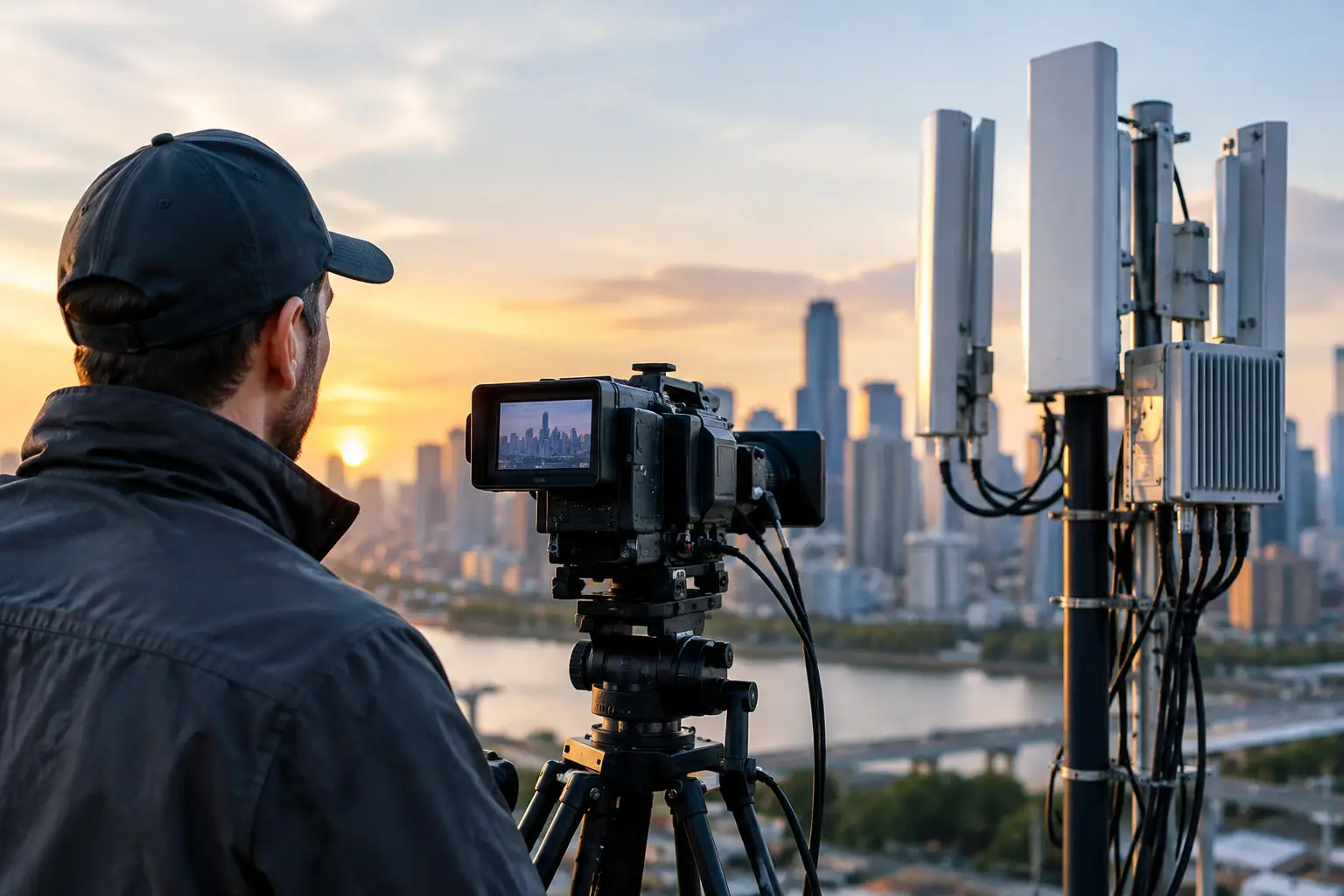
A packed match-day venue can lose a live feed long before its primary internet circuit goes fully down. Upload capacity gets consumed by guest traffic, a carrier route degrades, or a camera position lands behind concrete and steel. When you deploy cellular bonding for broadcasts, you create a second path for live video that is designed to keep moving when a single connection cannot.
For Atlanta bars, hotels, event spaces, sponsors, and production teams preparing for major sports traffic, cellular bonding is not a replacement for proper venue networking. It is a controlled resilience layer. Used correctly, it can protect a critical stream, support a remote contribution feed, or provide a fast recovery option when the wired network is compromised.
What cellular bonding does for a live broadcast
Cellular bonding combines bandwidth from multiple connections into one managed video path. Those connections may include several cellular carriers, venue Ethernet, dedicated internet, or satellite, depending on the hardware and service plan. The bonding platform continuously measures each path and distributes video packets across the available links.
The operational advantage is redundancy. If one carrier becomes congested, weak, or unavailable, the encoder can shift traffic to healthier paths without waiting for an operator to manually change networks. The result is not immunity from every failure. It is a better chance of maintaining an acceptable live feed while the underlying issue is isolated and corrected.
For high-visibility broadcasts, that distinction matters. A dropped stream can trigger refund requests, sponsor complaints, negative social posts, and a room full of customers who leave before the next round. A degraded feed may still be recoverable. The objective is to prevent a brief carrier problem from becoming a public business problem.
When to deploy cellular bonding for broadcasts
Cellular bonding is most valuable when the broadcast cannot depend on one local network condition. That includes remote camera positions, temporary fan activations, hotel ballrooms, rooftops, parking areas, mobile production units, and venues with uncertain upstream capacity.
It is also a practical contingency for locations that have a strong primary circuit but no meaningful failover. A wired connection can fail because of construction damage, provider maintenance, equipment faults, misconfiguration, or a power event upstream from the venue. Cellular paths use different infrastructure, which reduces the chance that one incident removes every option.
The technology is especially useful in three scenarios. The first is a primary path for an off-site crew that does not have access to managed Ethernet. The second is a backup path for a fixed broadcast position. The third is a temporary bridge while engineers recover a failed circuit or reconfigure a network.
Do not treat bonding as an excuse to skip capacity planning. A venue with overloaded WiFi, unmanaged guest devices, and no traffic separation will still create problems. Bonded cellular should protect the broadcast workflow, not carry the weight of an unprepared network.
Start with the stream, not the equipment
The wrong deployment begins with a shopping list. The right deployment begins with a broadcast requirement: which feed must stay live, where it originates, where it goes, and what quality level is acceptable under failure conditions.
Document the resolution, frame rate, codec, expected bitrate, audio channels, return-video needs, and maximum tolerable delay. A 1080p contribution stream at a stable 8 Mbps has very different requirements from a low-latency multi-camera production feed. If the stream must reach a cloud platform, a network control room, or a rights-holder distribution point, identify that destination before testing.
Then define the failure target. Some operations need uninterrupted transmission with a temporary quality reduction. Others can tolerate a short interruption but cannot accept high latency. A sports bar streaming a licensed match and a broadcaster sending a live correspondent feed are not solving the same problem.
This definition drives encoder selection, data-plan sizing, carrier count, antenna design, and the number of bonded units required. It also gives the operations team a clear standard for making decisions under pressure.
Measure upload performance at the actual camera location
A speed test near the venue office is not a field survey. Test from the exact locations where cameras, encoders, and production staff will operate. Signal strength can change dramatically across a building, especially in basements, kitchens, loading docks, suites, and dense public areas.
Run tests at the same time of day as the event whenever possible. Cellular networks can perform well during setup and deteriorate when thousands of spectators arrive nearby. Record upload throughput, packet loss, jitter, latency, and signal quality for each carrier. Repeat the test while guest WiFi and event equipment are active.
This data tells you whether a bonded system has enough independent capacity. Four weak connections do not automatically create a reliable path. Carrier diversity, clean signal, and stable upstream performance matter more than the number of SIM cards installed.
Build carrier diversity into the design
A reliable bonding setup uses multiple carriers, not multiple lines from the same carrier. If one carrier experiences a local congestion issue or a regional outage, the other carriers provide independent options. In Atlanta's event corridors, performance can vary by block, building orientation, and crowd density.
Use external antennas when the unit will remain in a fixed or semi-fixed location. Place them away from major obstructions and sources of RF interference. A bonding encoder buried in a rack, behind a television wall, or inside a vehicle can suffer avoidable signal loss. Antenna placement should be tested and documented, not improvised ten minutes before going live.
Data plans also need attention. High-quality video consumes data quickly, and some plans apply throttling after a threshold or restrict network priority during congestion. Confirm the actual terms, estimate usage for rehearsals and event duration, and keep room for extended overtime, retransmissions, and recovery testing.
Protect the local network from broadcast traffic
When wired internet is available, cellular bonding should work alongside it. Connect the broadcast system to a dedicated network segment or VLAN with defined bandwidth priorities. Keep production devices separate from guest WiFi, point-of-sale systems, staff devices, and building management equipment.
Quality of service can prioritize critical traffic, but it cannot create bandwidth that does not exist. If the venue's upstream circuit is saturated, no setting will rescue a high-bitrate stream. Measure real upload headroom and reserve capacity before doors open.
Cybersecurity matters here as well. Bonding equipment is often deployed quickly, which creates a temptation to use default credentials, open management access, or connect unapproved devices to production networks. Change credentials, restrict management access, apply current firmware, and confirm that remote support access is authorized before the event.
Test the failure, not just the feed
A green preview screen is not proof that the system is ready. The deployment must be tested under the conditions it is expected to survive.
Start the live workflow and deliberately remove one connection at a time. Disconnect a carrier, disable wired Ethernet, move the unit to a lower-signal position, and observe how the feed behaves. Watch the output at the actual destination, not only on the local encoder display. Measure how long recovery takes, whether latency changes, and whether the stream remains within the receiving platform's requirements.
Test power as well. A bonded unit, camera, switch, router, and antenna system can all be healthy until a single power strip fails. Use conditioned power or UPS coverage for critical equipment, and verify realistic runtime. If the production setup depends on a generator, test the transition and grounding plan.
Document a simple event runbook. It should identify the primary operator, escalation contact, carrier assignments, encoder profile, destination details, backup workflow, and the exact steps to take if the feed degrades. In a live incident, a short, accurate runbook is more valuable than a long technical manual nobody has time to read.
Assign active monitoring during the event
Bonding systems are built to react automatically, but they still need an accountable operator. Someone should watch signal quality, aggregate throughput, data consumption, encoder temperature, packet loss, and stream health from pre-show through teardown.
Set practical escalation thresholds. For example, act when two carriers show sustained degradation, packet loss rises beyond the stream's tolerance, remaining data allowance is low, or a bonded unit falls back to a single viable path. Early action gives technicians time to reposition antennas, reduce bitrate, move to a backup encoder, or shift to a preplanned camera location.
For major match days, the best response plan includes local engineering support. Remote troubleshooting has limits when the problem involves an antenna cable, a crowded RF environment, a failed switch port, or equipment that needs to be physically relocated. GDS Technology supports Atlanta operations where the response window is measured in minutes, not the next business day.
Make the fallback decision before the problem
Cellular bonding can preserve a broadcast, but every live operation needs a defined point where the team changes strategy. That may mean lowering bitrate, reducing resolution, switching to a single program feed, moving to a secondary location, or temporarily using a static backup source.
The key is to agree on that decision before the room is full and the stream is public. Define who has authority to change the profile, who communicates with stakeholders, and what message staff should use with customers if a visible interruption occurs. Fast decisions protect credibility.
Cellular bonding works best when it is treated as part of an event-readiness plan: tested, monitored, powered, secured, and supported. Put that plan in place before the first whistle. When the network is under pressure, preparation is what keeps the broadcast on air.