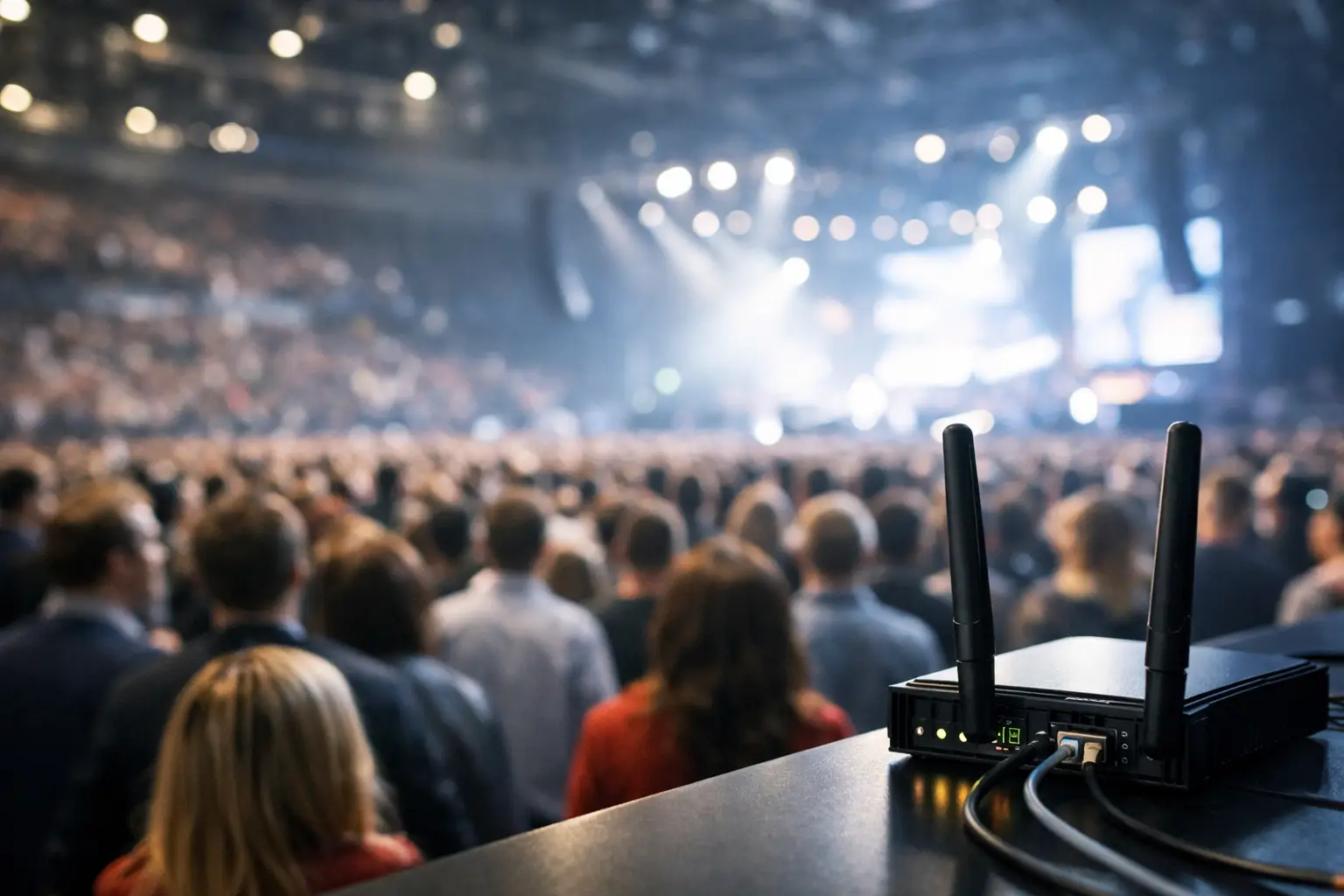
A full sports bar, hotel lobby, or event venue can turn a normal internet failure into a revenue event within minutes. Screens freeze, payment terminals slow down, guest WiFi becomes unusable, and staff lose the tools they need to respond. Can cellular backup handle crowds? Yes, but only when it is engineered as part of a match-day continuity plan, not treated as a plug-in replacement for a failed primary circuit.
For Atlanta operators preparing for World Cup traffic, the question is not whether a cellular connection can carry data. It can. The operational question is whether it can carry the right traffic, at the right time, through a local network that may be serving hundreds of guests and dozens of business-critical devices.
Can Cellular Backup Handle Crowds? It Depends on the Traffic
Cellular backup can protect essential operations during a primary internet outage. It is often effective for point-of-sale transactions, staff communications, reservations, operational dashboards, security alerts, and limited streaming recovery. It is not automatically capable of supporting every guest device, every public WiFi session, every cloud application, and multiple high-definition video streams at peak occupancy.
A crowded venue creates two separate capacity problems. The first is inside the building: guest phones, tablets, laptops, payment terminals, access points, cameras, digital signage, streaming devices, and staff systems all compete for wired and wireless resources. The second is outside the building: every nearby venue, fan zone, hotel, and spectator may be competing for the same cellular towers and backhaul capacity.
That distinction matters. A cellular router may show strong signal strength while the network is still congested. Four or five signal bars do not guarantee usable upload speed, low latency, or steady video performance when thousands of people are uploading clips, checking scores, ordering rides, and joining venue WiFi nearby.
Cellular Is a Failover Tool, Not a Capacity Promise
The right expectation is simple: cellular backup preserves prioritized business functions. It should not promise to recreate the bandwidth of a dedicated fiber circuit during a major event surge.
A well-designed system identifies what must remain online when the primary connection fails. For a sports bar, that may mean payment processing, one or two priority streaming paths, staff devices, guest management systems, and voice communications. For a hotel, it may include property-management systems, front-desk terminals, key-card operations, security monitoring, and a controlled amount of guest connectivity. For a broadcaster or event organizer, the priority may be contribution feeds, production communications, credentialing, and operational coordination.
Everything else needs a policy. Open guest WiFi should be rate-limited, moved to a lower-priority path, or temporarily restricted during failover. Automatic device updates, cloud backups, large downloads, and nonessential signage traffic should not be allowed to consume the same emergency connection supporting a live match and payment terminals.
This is why a basic cellular hotspot is rarely enough. It has no meaningful traffic control, limited antenna performance, uncertain carrier priority, and little visibility when conditions change. It may work in a quiet office. It is a weak contingency plan for a packed venue with public screens and a line at the bar.
What Determines Whether Cellular Backup Performs Under Load
Cellular performance is affected by more than the service plan or router model. The carrier network, local tower utilization, building construction, antenna placement, and the type of applications in use all influence results.
Streaming is especially demanding because it reacts poorly to inconsistent conditions. A speed test may briefly show enough download capacity for video, yet live content can still buffer when latency spikes or packet loss increases. Upload performance also matters for cloud point-of-sale synchronization, video calls, security systems, and venue operations.
Carrier congestion is the major unknown during a large event. A connection tested on a quiet Tuesday afternoon may behave very differently an hour before kickoff. Public cellular networks are shared environments. During concentrated demand, capacity can decline precisely when your venue needs backup the most.
Building layout can make the problem worse. Concrete, metal framing, low-emissivity glass, kitchen equipment, basement spaces, and interior utility closets can weaken cellular reception. An indoor router placed where it is convenient for cabling may be located in the worst possible spot for radio performance. External antennas, properly positioned equipment, and measured signal testing can materially change the result.
Build a Failover Plan Around Priorities
The most reliable approach uses intentional segmentation and traffic policies before the outage occurs. Your network should know which systems are business-critical and which systems can wait.
Start by separating guest WiFi from operational traffic. Payment terminals, streaming equipment, staff devices, security systems, and production equipment should not share an unrestricted network segment with hundreds of personal phones. Segmentation gives your team the ability to preserve revenue-critical services when capacity becomes constrained.
Next, define failover behavior. Some applications should move to cellular automatically. Others should remain blocked, throttled, or disconnected until the primary circuit returns. A controlled failover is better than allowing every device to discover the backup link and consume it at once.
Multi-WAN equipment can also make smarter decisions than a basic router. It can monitor circuit health, shift traffic by application, maintain separate paths for priority systems, and alert technical teams when the primary connection degrades before it fails completely. For high-stakes locations, dual-carrier cellular can reduce dependence on a single carrier network. It does not eliminate crowd congestion, but it gives the venue another path when one network is impaired.
Test at the Same Time the Crowd Will Arrive
A backup plan that has not been tested under realistic conditions is an assumption, not protection. Testing should include a forced primary-circuit outage, a check of automatic failover timing, validation of point-of-sale functions, and confirmation that priority streams remain stable.
The best test window is not early morning when the building is empty. Test during a busy service period, a major local event, or a planned load exercise that reflects expected demand. Measure download and upload throughput, latency, jitter, packet loss, streaming stability, and transaction performance. Then repeat the test with guest traffic active.
Venue teams should also rehearse the human side of the response. Who receives the outage alert? Who decides whether guest WiFi is restricted? Who verifies each screen, payment terminal, and operational system? Who contacts the carrier or local support engineer if failover does not perform as designed? A technical plan without ownership can still fail under pressure.
When Cellular Backup Is Not Enough
Some environments need more than a single primary circuit plus a cellular failover device. A large watch party, a production-heavy event, or a hotel serving hundreds of guests may require a second wired provider, diverse physical entry paths, a managed fixed-wireless option, or dedicated circuits for production and public internet use.
The higher the cost of downtime, the less sensible it is to rely on one backup method. If a venue loses thousands of dollars per hour when streaming or payment systems go down, redundancy should reflect that exposure. Cellular can be a critical layer, but it should sit within a broader resilience design.
GDS Technology evaluates that design at the venue level: carrier availability, antenna placement, WiFi density, network segmentation, streaming priorities, failover policies, and on-site recovery requirements. The goal is not to sell a generic backup connection. The goal is to keep the systems that protect match-day revenue working when the primary path fails.
For World Cup operations, plan for the moment when the room is full, the match is live, and the network takes a hit. Cellular backup can carry the load that matters most, provided you decide what matters most before the crowd arrives.