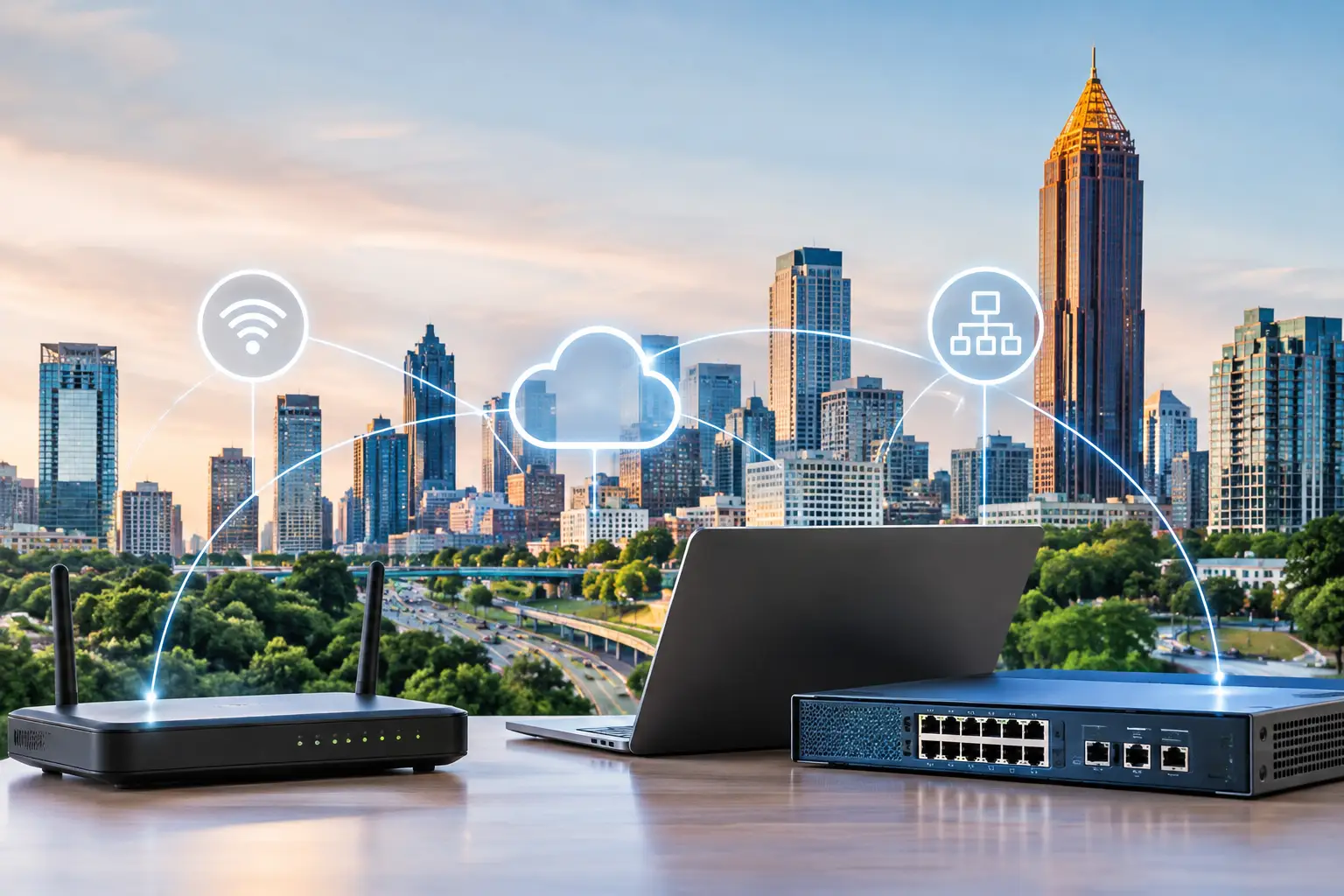
A packed sports bar loses its primary fiber connection 12 minutes before kickoff. Screens buffer, card payments slow, staff cannot access cloud systems, and guests start pulling out phones to find another venue. That is the operational reality behind backup internet versus SD WAN. They solve related problems, but they are not interchangeable.
For Atlanta hospitality and event operators preparing for World Cup-scale traffic, the question is not which technology sounds more advanced. The question is what keeps the stream live, transactions moving, guests connected, and staff in control when a circuit, carrier, router, or upstream route fails.
Backup Internet Versus SD WAN: The Core Difference
Backup internet is a second usable path to the internet. It may be a second fiber circuit, cable broadband, fixed wireless, 5G, or a managed cellular connection. Its job is straightforward: if the primary connection fails or becomes unusable, traffic has another way out.
SD WAN is the control layer. It uses software, policies, and multiple available network paths to steer business traffic based on application needs and real-time network conditions. It can recognize that a streaming platform is suffering packet loss on one circuit, move that traffic to another path, prioritize point-of-sale traffic, and apply security policy across locations.
A venue can have backup internet without SD WAN. In that case, a firewall or router may fail over from the primary circuit to the secondary connection. That can be enough for a small operation with a clear emergency need.
A venue can also deploy SD WAN without true backup internet, although that creates a serious gap. SD WAN cannot create a second path if only one circuit exists. It can optimize and secure the connection you have, but it cannot maintain operations through a carrier outage with no alternate link available.
The strongest design for high-visibility venues is often both: independent backup connectivity plus SD WAN intelligence to monitor, prioritize, and use every path effectively.
When Backup Internet Is the First Priority
If your venue relies on one internet provider and one physical connection, backup internet should come first. A sophisticated traffic-management platform does not protect revenue when a construction cut, provider equipment failure, power issue, or neighborhood outage takes out the only circuit.
The objective is independence. Two connections from the same carrier, entering through the same building entrance and terminating in the same local network facility, may look redundant on paper while sharing the same point of failure. Ask direct questions: Do the circuits use different carriers? Do they enter the building through different paths? Are they supported by different upstream networks? Is the backup device protected by battery power?
For a restaurant or sports bar, a business-grade cable or fixed wireless circuit can provide a practical secondary path behind primary fiber. For a hotel, major venue, broadcaster, or production operation, two diverse wired circuits may be necessary, with cellular as a third emergency option. The right design depends on traffic volume, building constraints, contractual obligations, and the cost of downtime.
Cellular backup deserves particular scrutiny. A 5G connection can be an effective lifeline for payment terminals, operations, and limited streaming traffic. It may not carry dozens of high-definition displays, hundreds of guest devices, cloud systems, and live production workflows during a sold-out match. Cellular performance also changes under congestion, and major events are exactly when nearby mobile networks become busy.
Backup capacity must match the minimum operating state you need to preserve. Decide whether the backup connection is intended to keep card payments alive, run the entire venue, support a selected group of screens, or protect a broadcast workflow. Those are different engineering targets.
What SD WAN Changes on Match Day
Traditional failover often waits for a circuit to go completely down. But not every damaging outage looks like a hard failure. A provider circuit can remain technically online while packet loss, jitter, DNS problems, or upstream congestion make video unreliable and cloud applications painfully slow.
SD WAN can detect these conditions and act on policy. It can send guest WiFi through one path while protecting payment processing and production systems on another. It can favor the circuit with lower latency for real-time services. It can shift approved applications before guests see buffering on every screen.
That is especially useful when a venue uses multiple internet services at once. Rather than keeping a costly secondary circuit idle until disaster strikes, SD WAN can use both links according to policy. The primary fiber may carry critical operations and managed streaming traffic, while a second circuit handles guest WiFi, software updates, and lower-priority browsing. If conditions change, traffic can be rebalanced automatically.
Not every application transitions cleanly during a failover. Some older systems maintain sessions tied to a public IP address. Some streaming devices, payment platforms, and remote-management tools need deliberate testing. SD WAN can reduce disruption, but it does not eliminate the need to validate how your actual applications behave under failure conditions.
Protect the Traffic That Protects Revenue
A common mistake is treating all internet traffic equally. On a major match day, that means a guest device download, a staff software update, and a payment authorization request can compete for the same limited capacity. When the connection is under pressure, the venue needs business rules, not hope.
Build a traffic priority plan before peak demand. Payment systems, managed streaming endpoints, staff communications, security systems, and production tools should be identified and treated according to their business impact. Guest WiFi matters to customer experience, but it should not be allowed to disrupt the systems required to serve customers.
A useful policy model separates traffic into four operational tiers:
- Revenue-critical services, including POS, payment processing, reservation platforms, and ordering systems.
- Event-critical services, including managed streams, broadcast equipment, score displays, and staff communications.
- Security-critical services, including cameras, access control, monitoring, and protected administrative access.
- Guest and general business traffic, including public WiFi, personal devices, background updates, and nonessential browsing.
SD WAN can enforce many of these priorities, but network segmentation still matters. Public guest WiFi should not share unrestricted access with payment, staff, or production networks. A fast secondary connection does not compensate for a flat network with poor access controls.
The Hidden Risks in “Automatic Failover”
Automatic failover is valuable only when it has been designed, monitored, and tested. Many venues discover too late that their backup line was disconnected, its modem was offline, its data plan was capped, or the firewall policy did not permit critical traffic over the secondary path.
Testing should go beyond unplugging a cable after business hours. Simulate primary-circuit loss, degraded packet quality, device reboot, and power interruption. Verify that POS terminals can authorize transactions, streams recover quickly, VPN-dependent systems reconnect, guest WiFi behaves as intended, and alerting reaches the right person. Record the results and correct failures before a high-profile event exposes them.
You also need ownership. A carrier may be responsible for its circuit, an equipment vendor for its appliance, and an internal team for local switches and WiFi. During a live event, those handoffs can consume the first critical hour. A response plan should identify who has authority to make changes, who contacts each provider, what credentials are available, and when on-site engineering support is required.
Choosing the Right Architecture for Your Venue
A single-location bar with several screens may need a primary wired connection, an independent backup circuit, a properly configured failover firewall, and a tested WiFi design. That is often the highest-value starting point.
A larger hotel, event venue, or multi-site hospitality group may need dual diverse circuits, cellular tertiary backup, SD WAN policies, segmented networks, centralized monitoring, and documented response procedures. If staff, guests, production teams, and security systems all depend on the network, basic failover alone is rarely enough.
Broadcasters and temporary event operations face another scenario. They may need portable connectivity, bonded cellular, pre-event site testing, prioritized uplink capacity, and engineers who can diagnose the difference between WiFi interference, local switching issues, provider degradation, and streaming-platform failure. The design must reflect the operational stakes, not just a generic bandwidth estimate.
Cost should be evaluated against the real impact of disruption. Lost food and beverage sales, abandoned hotel bookings, payment failures, refunds, staff overtime, emergency vendor fees, and reputational damage can exceed the monthly cost of a properly engineered secondary connection quickly.
Build for Failure Before the Crowd Arrives
Backup internet provides the path. SD WAN provides the decision-making. For many Atlanta venues, the answer is not backup internet versus SD WAN as a forced choice. It is a staged resilience plan that starts with truly independent connectivity and adds intelligent control where the traffic, risk, and visibility justify it.
GDS Technology helps operators validate that plan under real conditions: carrier diversity, failover behavior, streaming performance, WiFi capacity, network segmentation, and match-day response readiness. The best time to discover a weak backup path is during a controlled test, with engineers available and no room full of guests waiting for the match to start.